Turk Kardiyol Dern Ars. 2026; 54(7): 580-587 | DOI: 10.5543/tkda.2026.85533
Indication Phenotypes and Short-Term Clinical Outcomes in Patients Undergoing Left Atrial Appendage Closure: A Single-Center Real-World Experience from Türkiye
Aykan Çelik1, Alper Çağrı Ağdağ2, Semih Aktürk2, Emre Özdemir2, Sadık Volkan Emren21Department of Cardiology, İzmir Ataturk Training and Research Hospital, İzmir, Türkiye
2Department of Cardiology, İzmir Katip Celebi University, Faculty of Medicine, İzmir, Türkiye
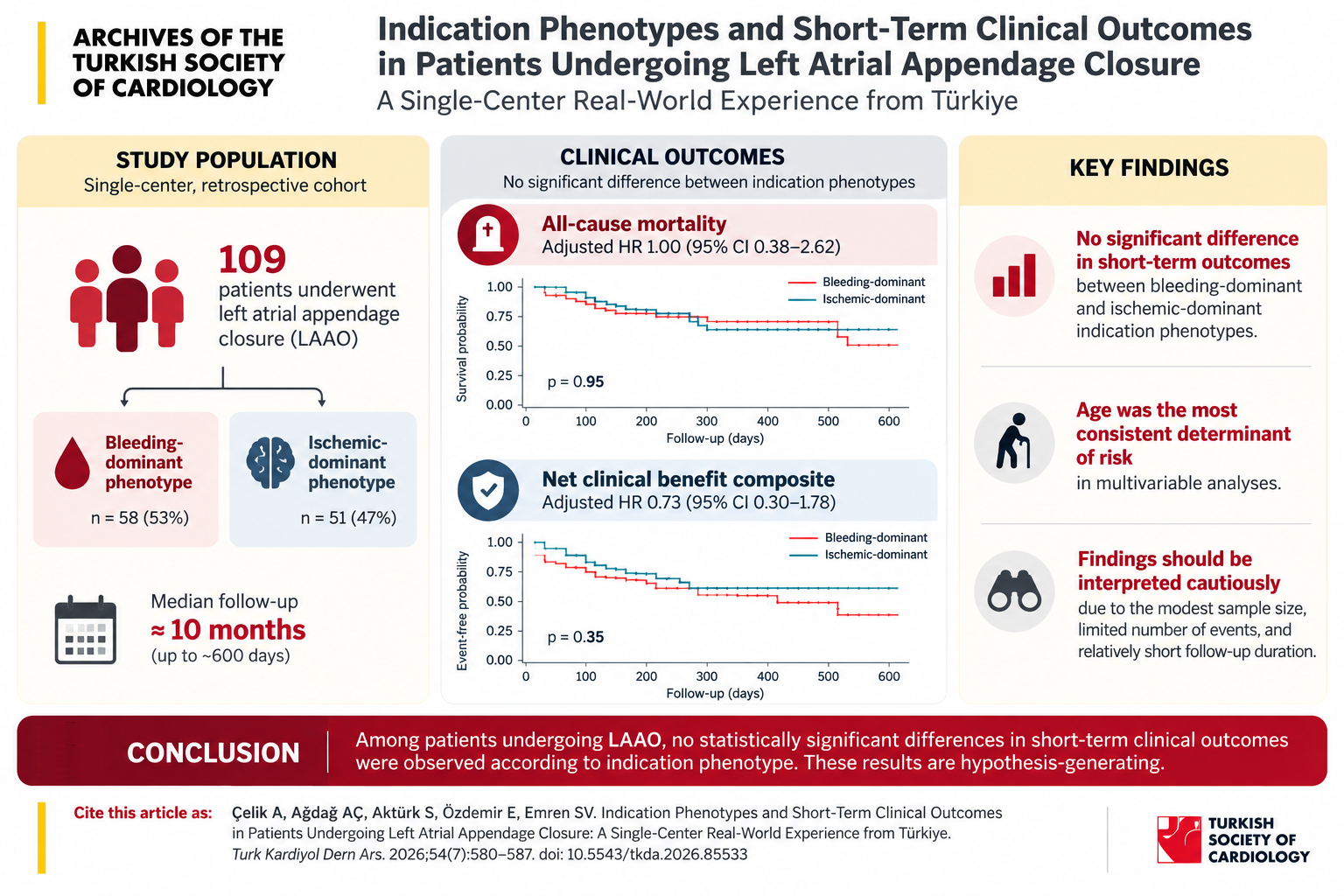
Objective: Left atrial appendage occlusion (LAAO) is widely used for stroke prevention in patients with atrial fibrillation who are unsuitable for long-term anticoagulation. However, whether clinical outcomes differ according to indication phenotype (bleeding-dominant versus ischemic-dominant) remains unclear. This study aimed to evaluate the association between indication phenotype and clinical outcomes following LAAO and to determine whether phenotype provides incremental prognostic value beyond traditional risk factors.
Method: In this retrospective single-center study, patients undergoing LAAO were classified as having either a bleeding-dominant or ischemic-dominant indication phenotype. The primary outcome was all-cause mortality. The secondary outcome was a net clinical benefit composite consisting of death, recurrent stroke, or major bleeding. Associations were assessed using Kaplan–Meier and Cox analyses, and the proportional hazards assumption was tested using Schoenfeld residuals. Sensitivity analyses were performed after excluding major bleeding from the composite outcome.
Results: A total of 109 consecutive patients were included. During a median follow-up of approximately 10 months, all-cause mortality occurred in 25.7% of patients, while the net clinical benefit composite occurred in 29.4%. No statistically significant association was observed between indication phenotype and mortality (adjusted hazard ratio [HR] 1.00, 95% confidence interval [CI] 0.38–2.62) or the composite outcome (adjusted HR 0.73, 95% CI 0.30–1.78). However, the wide confidence intervals reflect the limited sample size and event burden.
Conclusion: Among patients undergoing LAAO, no statistically significant differences in short-term clinical outcomes were observed according to indication phenotype. Age emerged as the most consistent determinant of risk. Given the modest sample size, limited number of events, and relatively short follow-up duration, these findings should be interpreted cautiously and considered hypothesis-generating.
Keywords: Atrial fibrillation, clinical outcomes, indication phenotype, left atrial appendage closure, risk stratification
Graphical abstract
Corresponding Author: Aykan Çelik
Manuscript Language: English