Turk Kardiyol Dern Ars. 2026; 54(5): 388-394 | DOI: 10.5543/tkda.2026.00457
Correlations Between Air Pollutants and Acute Coronary Syndrome Subtypes: A Six-Year Analysis
Abdulkadir Çakmak, Ömer KertmenDepartment of Cardiology, Amasya University Faculty of Medicine, Amasya, Türkiye
Objective: Air pollution is a major global public health concern and has increasingly been linked to cardiovascular diseases, including acute coronary syndrome (ACS). This study investigated the temporal association between air pollution and ACS case counts in Amasya, northern Türkiye.
Method: In this retrospective study, the medical records of 6,185 ACS patients treated at a single hospital were analyzed, including cases of ST-elevation myocardial infarction (STEMI), non-ST-elevation myocardial infarction (NSTEMI), and unstable angina pectoris. Environmental air pollutant levels, including particulate matter with an aerodynamic diameter ≤ 10 µm (PM10), particulate matter with an aerodynamic diameter ≤ 2.5 µm (PM2.5), nitric oxide (NO), and nitrogen oxides (NOx) were collected, and their temporal correlations with ACS case counts were evaluated. Seasonal variations in both the number of hospital admissions for ACS and pollutant concentrations were also analyzed.
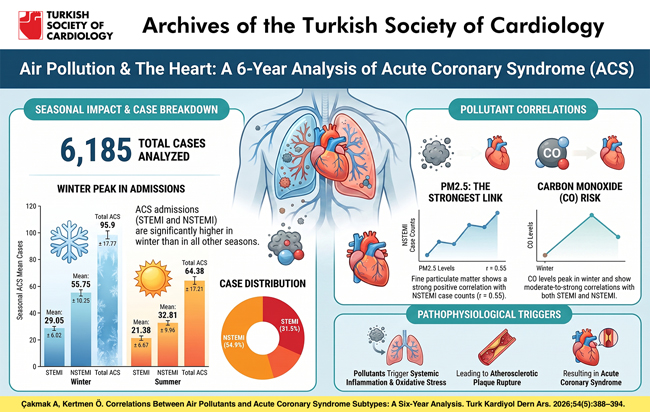
Results: Seasonal analysis revealed a significantly higher number of hospital admissions for acute coronary syndrome during winter compared with other seasons in this single-center study conducted in northern Türkiye (P < 0.05). Levels of particulate matter (PM10 and PM2.5) were also elevated in winter, with PM2.5 showing a moderate positive correlation with STEMI case counts (r = 0.38, P = 0.0005) and a strong positive correlation with NSTEMI case counts (r = 0.55, P < 0.0001). Nitrogen oxides (NO and NOx) also increased during winter but did not show significant correlations with overall ACS case counts.
Conclusion: Targeted public health strategies are required to mitigate pollution exposure, particularly during high-risk seasons. Further research using more accurate and higher-resolution pollution metrics and longitudinal data is warranted to deepen our understanding of the cardiovascular impacts of specific pollutants and to support the development of effective intervention strategies.
Keywords: Acute coronary syndrome, air pollution, particulate matter, seasonal variation
Graphical abstract
Corresponding Author: Abdulkadir Çakmak
Manuscript Language: English